Points
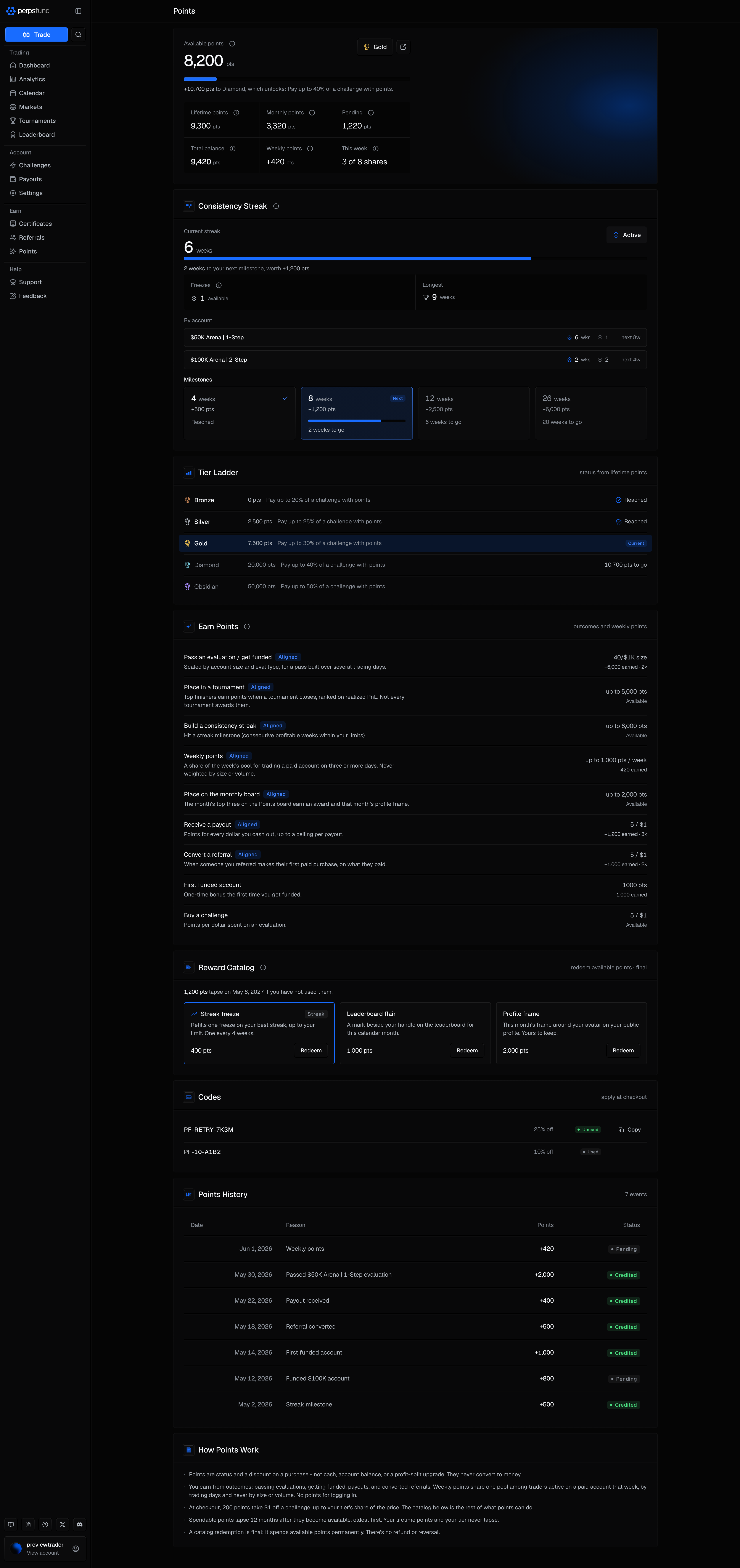
Earn points for the outcomes that show skill, a share of a weekly pool for trading a paid account, and a small per-dollar credit, and use them at checkout to take dollars off your next challenge. Points are status and a discount on a purchase, never cash.
Points reward the outcomes that show real skill and commitment (passing an evaluation, getting paid, placing in a tournament that awards points, staying consistent) and steady trading on a paid account, and you use them at checkout: 200 points take $1 off a challenge. They are status and a discount on a purchase, never cash, a balance top-up, or a change to your profit split.
How you earn
The largest awards are for outcomes. There is also a small per-dollar credit on the money you actually move, the challenge you buy and the payout you receive. The purchase credit is counted on what you paid: with a discount applied, on the discounted price. Trading a paid account on enough days in a week earns a share of that week's pool (Weekly points). There are no points for trading volume and none for logging in: trading more, or larger, never earns more. Tournament placement points are awarded only by tournaments that offer them: not every tournament does (see Tournaments).
| How you earn | Points |
|---|---|
| Pass an evaluation / get funded | 40/$1K size |
| Place in a tournament | up to 5,000 pts |
| Build a consistency streak | up to 6,000 pts |
| Weekly points | up to 1,000 pts / week |
| Place on the monthly board | up to 2,000 pts |
| Receive a payout | 5 / $1 |
| Convert a referral | 5 / $1 |
| First funded account | 1000 pts |
| Buy a challenge | 5 / $1 |
Points are earned on paid accounts. A paid account is one you bought, and the funded account it leads to. A free trial, a tournament account and an account granted to you free of charge do not earn the purchase, pass or first-funded points: a free trial that passes earns none. The first funded account bonus is credited when your funded account is issued, which is normally the moment you pass; if the account is held for a manual review, the bonus arrives with the funded account.
A counted trade. Two rules below look at your trades, and both use one definition. A trade counts when it is closed, was held for at least 2 minutes, had a notional size of at least 10% of the account size, and was not on a thinly traded market. A trading day is a UTC day on which at least one counted trade closed.
The pass points are for a pass built over several days. A pass earns its points when the account has at least 5 trading days and no single trade made more than 60% of the account's gross profit (the sum of its winning trades). A pass that misses either one is still a pass, and still funds you: it earns no pass points. There is still no minimum number of days to pass.
A payout earns up to 20,000 points. The per-dollar credit on a payout stops at that ceiling for one payout.
A referral earns on the first purchase. When a trader you referred makes their first paid purchase, you earn points per dollar they paid for it. Their later purchases earn you the commission, not more points.
A refunded or charged-back purchase takes its points with it. Every credit earned on that account is reversed, not only the purchase credit: the pass, the first-funded bonus if that account earned it, its streak milestones, its weekly points, and the points the trader who referred you received for it.
No points for volume or logins
You never earn points for trading more, trading larger, or signing in. Points come from outcomes (passing, getting funded, a placement in a tournament that awards points, a consistency streak, a converted referral), from weekly points, which count the days you traded a paid account and never how much, and from a small per-dollar credit when you buy a challenge or take a payout.
Weekly points
Each week, Monday to Sunday (UTC), one pool of points is shared among the traders who were active on a paid account. It is paid early the following Monday.
Who shares it. You share the week's pool when a paid account of yours had at least 3 trading days that week and did not breach in it. A trading day is a UTC day on which a counted trade closed (both are defined under How you earn). A free trial and a tournament account do not count.
How many shares.
| What | Shares |
|---|---|
| Each trading day, up to 5 | 1 |
| The week ended in profit | 2 |
| No day used more than 50% of the daily loss limit, and no oversized re-entry after a loss | 1 |
| The most one trader can hold | 8 |
- Shares are never weighted by account size, volume or profit in dollars. Two traders with the same week earn the same, whatever their account size.
- An oversized re-entry is a position opened within 60 minutes after a losing trade closed, at 1.5 times the median size of your trades that week up to that loss, or more.
- One award per trader. With more than one paid account, the account with the most shares counts. They are not added together.
- At most 1,000 points a week for one trader.
- The pool changes week to week. It is set from recent challenge sales and shared by everyone's shares, so a share is worth a different number of points each week, and in a week with no pool it is worth none. Points you earned from the other rules are never reduced to make room for it.
- Opposite positions across linked accounts earn nothing. If two of your accounts, or your account and one linked to you by a shared device or payout address, held opposite positions in the same market at the same time during the week, neither side shares the pool.
Weekly points are a credit like any other: they are held for 7 days, then become available, and they count toward your lifetime points and your tier. The Points page shows Weekly points (last week's figure) and This week: your trading days until you reach 3, then your shares from trading days. The shares for a profitable week and for discipline are counted when the week closes.
Monthly points and the Points board
Monthly points are the points you earned in the calendar month, in UTC, counted at the normal rate. They start again on the 1st. The Points page shows them beside your lifetime and available points.
The Leaderboard has a Points board for the month. It ranks a narrower figure than the one on your Points page:
- It counts points from passes, streak milestones, weekly points, tournament placements and referrals.
- It leaves out purchase points and payout points. Those are earned per dollar, so a public total would show what you spent or were paid, and a place on the board cannot be bought.
- You are listed only with Public profile on (Settings). With it off, nobody sees you on the board, and you still see the place you would hold.
- The month's top three each earn a placement award (2,000, 1,000 and 500 points) and that month's profile frame, and stay on the page through the following month. The award comes out of the same weekly allowance as the pool: in a week with no room for it, no award is paid. The top three and their frames stand either way.
Consistency streak
Every account you trade builds its own weekly streak: an evaluation, a free trial, a tournament account and a funded account alike. You do not need to be funded to start one.
- A streak week is a UTC week, Monday to Sunday, that the account finished in profit and without a breach, with at least 3 trading days, at least 5 counted trades, and a return for the week of at least 0.5% (a counted trade and a trading day are defined under How you earn). Streaks are scored early on Monday for the week that just ended.
- Each streak week adds one to the account's streak.
- A profitable week that falls short of those floors changes nothing. The streak does not grow, does not break, and no freeze is used.
- Freezes. An off week (not profitable, but no breach) uses a freeze instead of ending the streak. You hold up to 2, and every 4 weeks of streak earns one back. With no freeze left, an off week resets the streak.
- A breach resets it, whatever freezes you have.
- Opposite positions across linked accounts do not count. If two of your accounts, or your account and one linked to you by a shared device or payout address, held opposite positions in the same market at the same time during the week, that week is not counted for either account: like a short week, it changes nothing.
Milestone points are paid once per trader. Reaching a milestone (the streak row in the table above) earns its points the first time any of your accounts reaches that length, on an account you bought or the funded account it led to. A second account reaching the same length does not earn them again, and a free trial or tournament account shows its streak without earning milestone points.
The Consistency Streak panel shows your best current streak. With more than one account it adds a By account list, and a free trial or tournament account is named as one. An account that has passed, breached or ended leaves the list; its streak stops there.
Tiers
Your tier is a status level set by your lifetime points earned, the running total of everything you have ever earned, counted at the normal rate (see Points boosts). Because it counts what you earned and not what you hold, spending points on rewards never drops your tier: it only ever rises. There are 5 tiers, and the tier is the platform's recognition of how far you have come rather than a gate on any feature.
| Tier | Lifetime points | At checkout |
|---|---|---|
| Bronze | 0 | Pay up to 20% of a challenge with points |
| Silver | 2,500 | Pay up to 25% of a challenge with points |
| Gold | 7,500 | Pay up to 30% of a challenge with points |
| Diamond | 20,000 | Pay up to 40% of a challenge with points |
| Obsidian | 50,000 | Pay up to 50% of a challenge with points |
Each tier has one perk: how much of a challenge you can pay with points. The table's last column is the largest share of one challenge price your points may cover at that tier. A higher tier does not give you a discount by itself; it lets you spend more of your own points on one purchase. No other perk is attached to a tier.
Points boosts
From time to time we run a points boost: for a set window, the points for passing (or getting funded) and for buying a challenge are multiplied, for example 2×. A boost can cover every product and size, or only some.
- When it counts. A credit is boosted if the event happens inside the window: the pass itself, or the confirmed purchase. When the points appear in your history does not matter.
- What it covers. Only the pass or funded credit and the purchase credit, and only the ones a given boost names. Payouts, referrals, the first-funded bonus, tournament placements and streaks are never boosted.
- One boost at a time. If two boosts overlap, the higher one applies. They never multiply together.
- Boosted points spend like any other, and are held for the same period. They do not raise your tier: your lifetime points earned counts every credit at its normal rate, so a one-week boost cannot lift your tier for good.
- If a boosted purchase is refunded or charged back, all of its points come off, boost included.
Paying with points
At checkout, under the total, Pay with points shows your available points and how much of this price they can cover. Use the minus and plus buttons to move in steps of 200 points, or Use max. The total updates as you go, and the list price shows beside it.
| Rule | Detail |
|---|---|
| The rate | 200 points = $1 off a challenge, whatever you buy. |
| The most you can use | A share of the price set by your tier, and never more than your available points. |
| One reduction per purchase | Points, a coupon code or a promotion, never two. Using points removes an applied code, and a promotional price cannot take points. If you were referred, points replace the welcome discount on that purchase. |
| Crypto and card | Points work the same on both. |
| When they are taken | Your points are set aside the moment the payment is created, so they cannot be spent twice. |
| If the payment does not complete | A payment that expires or fails gives the points back. So does starting a different order. |
| If the purchase is refunded | The points you used come back, and the points that purchase earned are removed. |
The points you earn for the purchase are counted on what you paid after the points came off.
After a breach, you can cover more. For 14 days after an account breaches, you can pay up to 50% of the price of the same challenge type and size with points, whatever your tier. An account locked for a chargeback or fraud review does not count as a breach.
The catalog
The Reward Catalog on the Points page is the rest of what points can do. Every item listed can be redeemed. Redeeming asks you to confirm first and shows what your available balance will be afterwards. A redemption is final: the points are spent and are not refunded.
| Reward | Cost | Status |
|---|---|---|
| Streak freeze | 400 pts | Redeemable now |
| Leaderboard flair | 1,000 pts | Redeemable now |
| Profile frame | 2,000 pts | Redeemable now |
- Streak freeze. Adds one freeze back to your best streak, up to the limit of 2. You can buy one every 4 weeks. It needs a streak underway, and it is refused, with nothing spent, when your freezes are already full.
- Leaderboard flair. A mark beside your handle on the leaderboard for the calendar month you buy it in. It says nothing about performance.
- Profile frame. That month's frame around your avatar on your public profile. It is yours to keep; each month has its own design, and one of each month's can be bought.
Discount codes are no longer issued: points come off the price at checkout instead. A code you redeemed earlier is listed under Codes on the Points page and still works, for your account only.
On a computer, Points in the sidebar reads Reward while your available points cover a catalog item. A collapsed sidebar shows a dot instead.
When points lapse
Points you can spend lapse 12 months after they become available, oldest first. What you spend always comes off your oldest points, so the points that lapse are only ones you never used.
- Your lifetime points and your tier never lapse. A lapse lowers what you can spend, not what you have earned.
- The Points page shows the next lapse: the date and how many points, above the catalog.
- You are told first. An in-app notice arrives 30 days before points lapse.
- A lapse shows in Points History as its own line.
Your balance and history
The top of the page shows these figures:
| Figure | What it is |
|---|---|
| Available points | What you can spend right now. |
| Lifetime points | Everything you have ever earned, at the normal rate. It sets your tier and never goes down. |
| Monthly points | What you earned this calendar month (UTC). See Monthly points. |
| Pending | Points you earned that you cannot spend yet. Each credit is held for 7 days, then becomes available on its own. A credit can also be held for a review of the account; it stays Pending until the review clears it. |
| Total balance | Available plus pending. |
| Weekly points | Your share of last week's pool. See Weekly points. |
| This week | Your trading days this week, then your shares from them. |
The share button on the panel opens the points share card: your lifetime points, your tier and your current streak, as an image to save or post.
Points History also lists what you spent (points used at checkout, catalog items) and anything that lapsed, each as its own line with a minus sign.
Your lifetime earned is a separate running total of everything you have ever earned, at the normal rate (a boost's extra points are not in it). It drives your tier and never goes down, even when you redeem. Points for a payout are dated to when you requested it, not when it was sent, so their hold starts from your request. Below the catalog, Codes lists every code you have redeemed, each marked Used or Unused, and Points History lists your points events with their date, reason and status.
Points are status and a discount on a purchase, never cash
Points are not money. They are never paid out, added to your account balance, or converted into a higher profit split. Their value is your tier (status), the dollars they take off a challenge at checkout, and the catalog.
Related
- Tournaments - placement points, in the tournaments that award them.
- Referrals - convert a referral for points, alongside the cash commission.
- How it works - passing and getting funded, the largest points awards.