Trading rules
Every rule an account is held to: the profit target, the drawdown limits, the daily reset, breach, leverage, position sizing, per-market position caps, fills, fees, and funding, all read from the live engine.
An evaluation is one job: hit a profit target without breaking the risk limits. Everything here is enforced by the same engine that runs your account, and every number on this page is rendered from the configuration that engine runs on.
These are the terms for an account bought today
An account keeps the terms it was bought under. Its loss floors and its profit split are written onto the account when it is created and the engine reads them from there, not from the rules as they stand today, so a later change to those numbers does not move an account that is already open. Changes are dated in the changelog and are not applied to an account that is already open unless the change is in your favour, meaning it corrects a defect or loosens a limit.
Your account is a simulated (paper) account priced on live prices. The rules below govern it from the moment you start until you pass or breach, and they keep applying on the funded account a pass earns you.
The evaluation types
This page documents 4 types. 3 of them are on sale on the Challenges page: Arena | 1-Step, Gauntlet | 1-Step, and Hyper | 1-Step. Arena | 2-Step is not currently sold; it stays in the table because accounts opened on it are still measured against its rules.
The types differ in how many phases you trade, the profit target, and the drawdown limits. The account sizes, the profit split and the absence of a time limit are the same on all of them, so the only things that separate them are the price and the difficulty.
| Evaluation | Phases | Profit target | Daily loss | Max drawdown | Profit split |
|---|---|---|---|---|---|
| Arena | 1-Step | 1 phase | +10% | 3% | 6% | 80% |
| Gauntlet | 1-Step | 1 phase | +12% | 3% | 5% | 80% |
| Hyper | 1-Step | 1 phase | +9% | 3% | 3% | 80% |
| Arena | 2-Step | 2 phases | +5%, then +10% | 5% | 8% | 80% |
A single-phase type (Arena | 1-Step, Gauntlet | 1-Step, or Hyper | 1-Step) funds you as soon as you pass its target. The Arena | 2-Step splits its target across two phases, both shown in the matrix: you clear the first phase, then the second.
Among the single-phase types, Gauntlet | 1-Step asks for the most profit and Hyper | 1-Step asks for the least. Hyper | 1-Step also has the tightest max drawdown of any type, while its daily loss limit is the same as the other single-phase types. That is what its lower price buys you: a smaller target inside a tighter corridor, not an easier evaluation.
The profit target
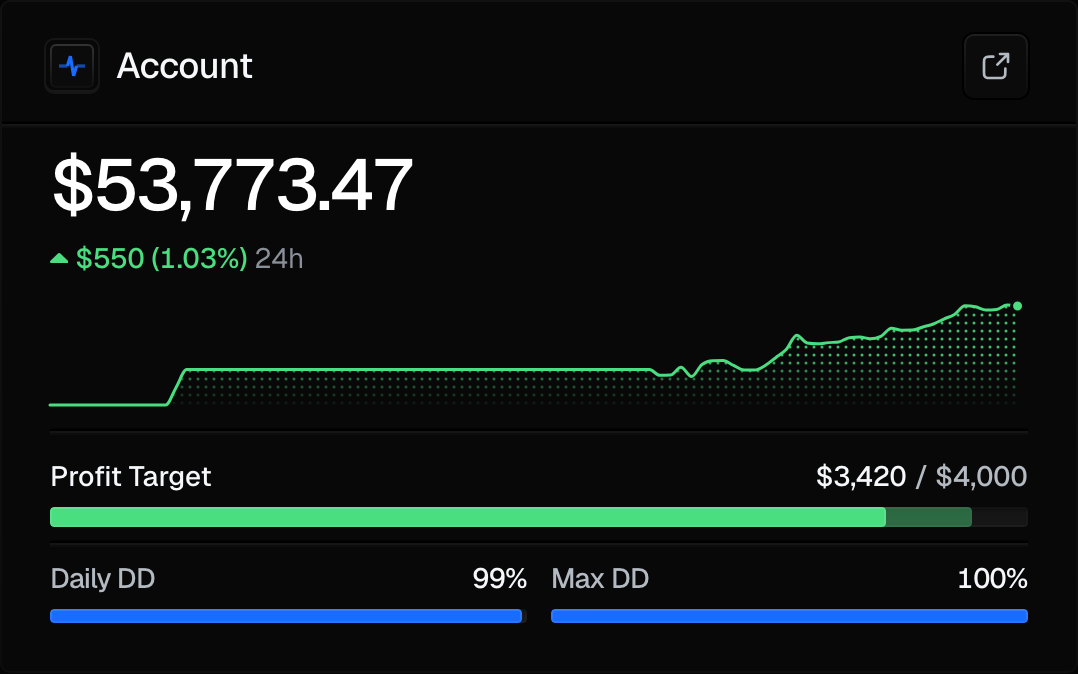
You pass by reaching your account's profit target on realized balance, with every position closed, and the pass is automatic: the moment your equity, after the taker fees to close every open position, reaches the target, we close all of your positions at the market price and the account passes on the booked balance that close produces. The fees are counted before we close, so the close lands you at or above the target. If you close a winner past the target while a losing position is still open, you pass once that position is closed with the balance still at the target.
On a single-phase type, passing funds you; on the Arena | 2-Step, clearing phase 1 advances you to phase 2 (balance and limits reset to the phase-2 baseline), and clearing phase 2 funds you. Your funded account is a new account that starts at your account size, with both loss floors measured from it, and you keep 80% of the profit. It is issued automatically once the pass is booked, unless the account is held for a manual review, in which case it is issued after that review.
Passing an evaluation you bought also earns points when the pass was built over at least 5 trading days with no single trade above 60% of the gross profit; a pass that misses either is still a pass and still funds you. The first funded account you are issued earns a one-time bonus. A free trial's pass earns neither. Trading a paid account on at least 3 days in a week, without a breach, also earns a share of that week's weekly points; the share never depends on account size or volume.
The challenge you passed stays in your account list, read-only, with its trades and history. You can archive it from the account switcher to hide it from the default views, and unarchive it later; archiving changes nothing in your data. See the Dashboard.
The drawdown model
Two loss limits protect the account, and both are measured on your equity (your balance plus the open profit and loss on your positions):
- Max drawdown is static: a fixed floor set from your starting balance when the account is created. It does not move up or down.
- Daily loss is trailing: it resets each day and ratchets up as you bank new highs during the day (see the reset below).
The exact percentages differ by evaluation type (the matrix above); the mechanic is the same for every one of them.
An open loss can breach you; an open gain passes you by being closed
Because the limits are measured on equity, an open losing position can breach the account before you close it. The profit target is measured on realized balance with every position closed, and you do not have to do the closing: when your equity, net of the fees to close, reaches the target, we close every position for you and the pass is booked. In short: your losses count live, and your gains pass you the moment they are enough to clear the target once closed. Exactly how equity is measured, with worked examples, is in Equity-based limits.
The daily loss limit and its reset
The daily-loss floor resets once a day at 00:00 UTC, in two steps:
- The day that is ending is checked first. If your equity is at or below that day's floor at 00:00 UTC, the account breaches. The reset never moves the floor out from under a breach.
- The new day's floor is set below what your account could bank at that moment: the lower of your balance and your equity after the taker fees to close every open position. With no positions open, that is your balance. Open profit does not raise it until you bank it; an open loss and the fees to close lower it. If a position cannot be priced at the reset, the floor is not raised.
During the day the floor trails up when you bank a new high: each time a close lifts what you could bank above the day's mark, the floor rises with it (it never falls until the next reset). A realized gain offset by a loss you are still holding is not a new high. So the daily limit is measured against the day's highest bankable value, not only where you started the day.
A loss held over midnight does not count against the next day
The new day's floor is set from a value that already has your open losses in it, so a loss still open at 00:00 UTC no longer counts against the next day's limit: only what you lose from there does. This loosens the daily limit for anyone holding a losing position over the reset. It applies from the 00:00 UTC reset on 12 September 2026 (see the changelog).
Breach and what happens
Touching either floor breaches the account (the check is inclusive). The same test runs everywhere a breach can happen: the continuous monitor, the 00:00 UTC reset, and every close you make, so a close that leaves your equity at or below the daily floor or the max drawdown floor breaches the account on that close, on an evaluation and on a funded account alike (changelog).
On a breach, all open positions are closed at the floor price, so the realized loss is capped at the drawdown, and the account is marked failed. There is one liquidation on these accounts: it is your account breach, shown on each position as a price, not a separate per-trade liquidation. See Breach and liquidation. A breached account can be archived from the account switcher like a passed one. If you think a breach is wrong, see If a breach looks wrong.
After a breach you can start a new challenge straight away. For 14 days you can pay up to 50% of the price of the same challenge type and size with points.
A tournament account follows the limits its own tournament sets, which can differ from the table above. See Tournament.
On a funded account
A funded account trades under the same limits, the same daily reset and the same breach rule as the evaluation that earned it. Two things are specific to it: a breach forfeits its unpaid profit share, and a paid payout resets it.
A breach on a funded account forfeits its unpaid profit share
When a funded account breaches, the profit share it had earned and not yet withdrawn is voided. It shows in your payout history as a Forfeited row, and it cannot be requested. Restoring the account after a review does not by itself return it. See the changelog.
When a payout from a funded account is paid, that account's balance goes back to its starting balance and both loss floors are set again from it; the profit already paid is never offered again. A payout therefore needs the account to be flat when you request it. Details are on Payouts.
Leverage
Leverage is capped per market by firm policy, never above what the venue allows:
| Asset tier | Max leverage |
|---|---|
| Majors - BTC, ETH | 5x |
| Stocks, indices, commodities, FX | 4x |
| Other crypto | 2x |
Position sizing
Your position size scales with the leverage you select: a single position can be worth up to your equity times that leverage, and the total margin used across all your positions is bounded by your equity. A second, per-market cap also applies (next section), and whichever is tighter decides.
| Limit | Value |
|---|---|
| Max single position | up to equity × leverage, and never above the market's per-asset cap |
| Total margin used | ≤ your equity |
| Minimum order | $10 |
A single max-leverage position uses your whole equity as margin, so it reaches the total-margin limit on its own; several smaller positions share that same equity budget. How these are enforced at order time is in Position sizing and leverage.
Per-asset position caps
Every market also has an absolute cap on how large one account's position in it can be, whatever your account size or leverage. It is measured on the position you would hold after the order fills, so an order that adds to a position counts what you already hold. The cap depends on the market:
| Market | Largest position per account |
|---|---|
| BTC, ETH | $1,000,000 |
| SOL | $300,000 |
| HYPE | $250,000 |
| Stocks, indices, commodities, FX | $1,000,000 |
| Other crypto with more than $100M of open interest | $150,000 |
| Every other market (including Pre-IPO) | 5% of its open interest, rounded to the nearest $1,000, between $50,000 and $100,000 |
| Any market whose open interest cannot be read | $50,000 |
Open interest is read from Hyperliquid. Where a market's cap depends on its open interest (the last rows of the table) and that open interest cannot be read at the moment, the market takes the lowest cap in the table rather than a higher one.
How the cap works with your orders:
- The tighter cap binds. The equity-and-leverage limit above and this per-market cap both apply, and an order must fit inside both.
- Reducing is always allowed. A reduce-only order or a close is never checked against the cap, so you can always get out of a position.
- A position already over its cap is held, not cut. If a position is larger than its cap today (because the cap or the market's open interest changed after you opened it), nothing closes or trims it. You can keep it, reduce it or close it, but you cannot add to it until it is back under the cap.
- A rejected order says so plainly. An order that would take you over the cap is refused with the message Max position for [market] is [cap] (this order would take you to [amount]).
- A resting limit order waits. If a resting limit order would take you over the cap at the moment it fills, it stays resting instead of filling. You can cancel it at any time.
The terminal's order panel sizes against the same caps, so the largest size it offers already includes this one. The cap took effect on 2 September 2026 and is dated in the changelog.
Fees
The simulated trading fee is charged on notional, the same on evaluation and funded accounts:
| Fee | Rate |
|---|---|
| Taker (market orders and marketable limits) | 0.045% |
| Maker (resting limit orders that fill) | 0.015% |
How fills are priced
Prices come from Hyperliquid. The simulation fills at that price and does not model order-book depth, so the size of your order does not move its fill price. Size does decide whether a market order may open at all: see Max slippage below.
| Order | Fills at |
|---|---|
| Market | The live price when the order arrives. If that price has moved more than 0.5% from the price the terminal showed you, the order is refused instead of filled. A market order that opens or adds to a position is also refused when its estimated slippage is above your max. |
| Limit that rests | Its own limit price, when the market reaches it, even if the market moves through your price in one jump. A reduce-only limit is no exception. |
| Limit that is already marketable when you place it | Like a market order: the live price, which is never worse than your limit. |
The rule that a resting limit fills at its own limit took effect on 3 September 2026 and is dated in the changelog. Order types and the order panel are covered in Placing an order.
Max slippage
A market order that opens or adds to a position is rejected whole if its estimated slippage is above your max slippage, whether you place it from the order panel or send it through the API. Nothing is partly filled.
- The estimate is the average price your size would fill at on Hyperliquid's live order book, against the mid price. The server works it out again when the order arrives, and its answer is the one that counts. If the order book cannot be read at that moment there is no estimate, and the order is not refused for slippage.
- Your max starts at 8%. You can set it from 0.1% to 30%, to one decimal place, in the order panel. It is saved per account. An order sent through the API is held to the max it names, inside the same bounds, or to that starting value when it names none.
- An order larger than the book can fill is rejected as well.
- Closing is never limited. A manual close, Close All, Reverse, a reduce-only order, and stop-loss and take-profit fills are not subject to max slippage.
This rule took effect on 2 October 2026 and is dated in the changelog. The order panel's row and editor are covered in Placing an order.
Take-profit and stop-loss levels
A level on an open position has to sit on the correct side of the current price, not your entry:
| Position | Stop-loss | Take-profit |
|---|---|---|
| Long | Below the current price | Above the current price |
| Short | Above the current price | Below the current price |
A stop at your entry or in profit is valid, so you can lock in a gain once the price has moved your way. A level at or past the current price is refused, because it would trigger at once; if no price is available, your entry is used instead. A stop-loss past your take-profit is refused. A triggered level closes the position at market and pays the taker fee. The same rule applies in the terminal, on the chart and through the API. How to set levels is covered in Placing an order.
Funding
Funding is simulated on open positions, charged or credited hourly at real Hyperliquid funding rates (longs pay and shorts receive when funding is positive, and the reverse when it is negative). It moves your realized balance like any other cost, so it counts toward your limits and your target.
What we do not require
There is no minimum number of trading days, no time limit or expiry, and no consistency rule. You can pass in a single day or over a month, in one trade or a hundred. The only things that end a phase are hitting the target or breaking a limit.
Related
- The Rules - the full authoritative rulebook, with worked examples for every limit.
- How it works - the evaluation types and the path to getting funded.
- Terminal - where the limits are shown live as you trade.
- Payouts - how you withdraw your profit share once funded.
- If a breach looks wrong - what is recorded and how to dispute a breach.